
spiceplace
Administrator
About the Candy Stages
Candy Stages are a result of the Cold Water Test. To use the Cold Water Test:
1. Place a cup of cold water into a Pyrex measuring cup.
2. Remove candy from heat.
3. Spoon 1/2 teaspoon of syrup into the cold water. Use care as the syrup will be very hot and can cause severe burns.
4. Pick the candy up from the cold water and roll into a ball.
5. Use the table below to determine the Candy Stage
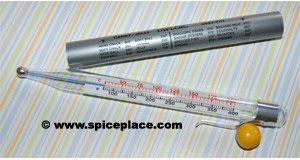
It's much easier though to use a candy thermometer. Below is a picture of a glass candy thermometer, and below that a chart of candy making temperatures. Note our candy thermometer came with a plastic sleeve to protect it from breaking in the utensil drawer.
Candy Making Temperature Chart
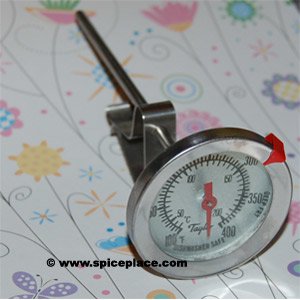
Below is a picture of another type of candy thermometer. This candy thermometer is made of metal and has a sliding arrow that allows you to point to the temperature your going to heat the candy to. Note that both the glass and metal candy thermometers have clips to attach to the pan the candy is being heated in.
Candy Stages are a result of the Cold Water Test. To use the Cold Water Test:
1. Place a cup of cold water into a Pyrex measuring cup.
2. Remove candy from heat.
3. Spoon 1/2 teaspoon of syrup into the cold water. Use care as the syrup will be very hot and can cause severe burns.
4. Pick the candy up from the cold water and roll into a ball.
5. Use the table below to determine the Candy Stage
- Soft Ball - The candy will roll into a soft ball, and will quickly remove its shape when removed from the water.
- Firm Ball - The candy will roll into a firm but not hard ball. It will flatten out after being removed from the water.
- Hard Ball - The candy will roll into a hard ball which has lost most of its plasticity and will roll around on a plate after being removed from the water.
- Light Crack - The candy will form brittle threads in the water and will soften when removed from the water.
- Hard Crack - The candy will form brittle threads in the water and will remain brittle when removed from the water.
- Caramelized Sugar - The sugar melts and becomes golden brown. It will form a hard brittle ball in the cold water.
It's much easier though to use a candy thermometer. Below is a picture of a glass candy thermometer, and below that a chart of candy making temperatures. Note our candy thermometer came with a plastic sleeve to protect it from breaking in the utensil drawer.
Candy Making Temperature Chart
- Fondant, Fudge 234-238° f Soft Ball
- Caramel, Divinity 245-248° f Firm Ball
- Taffy 265-270° f Hard Ball
- Butter Scotch 275-280° f Light Crack
- Peanut Brittle 285-290° f Hard Crack
- Caramelized Sugar 310-331° f Camarelized Sugar
Below is a picture of another type of candy thermometer. This candy thermometer is made of metal and has a sliding arrow that allows you to point to the temperature your going to heat the candy to. Note that both the glass and metal candy thermometers have clips to attach to the pan the candy is being heated in.

