Mixing basic food colors to create other unique colors

General Guidelines for food colors
Add food color gradually, a little at a time, to obtain desired shade.
Colors are strong — a little goes a long way.
Most home recipes call for 2–5 drops per batch.
Coloring eggs is different — boiling water is dilutes colors — and eggs need more color.
Less drops: paler shade.
More drops: deeper shade.
Remember the food’s base color will change during baking. A pale batter may turn brown, which affects the final color. Consider adding a dash more color to
make up for dark finished colors.
Tips for coloring Eggs
- Add 1 tbsp vinegar and 1/4 tsp of desired food color to 2 cups of boiling water.
- Using a slotted spoon, place hard cooked eggs into coloring solution for 5 minutes or longer.
- Remove eggs from coloring solution, and let dry. Once dry, color will not rub off.
- For other colors, refer to chart below.
Food Color Mixing Chart*
| Colors | For Icings and Baked Goods | For Colored Eggs |
| Orange Sunset | 5 Parts Yellow + 1 Part Red | 17 Parts Yellow + 3 Parts Red |
| Raspberry | 3 Parts Red + 1 Part Blue | 14 Parts Red + 6 Parts Blue |
| Purple | 6 Parts Red + 4 Parts Blue | 5 Parts Red + 15 Parts Blue |
| Jungle Green | 3 Parts Blue + 5 Part Yellow | 7 Parts Blue + 13 Part Yellow |
| Watermelon Red | 24 Parts Red + 2 Parts Blue | 25 Parts Red + 2 Parts Blue |
| Teal | 5 Parts Blue + 2 Parts Yellow | 12 Parts Blue + 7 Parts Yellow |
*Parts can be any measurement you need, drops, teaspoons, tablespoons, cups,
etc. For example, for Raspberry, you could mix 3 drops red with 1 drop blue for icings and
baking.
You can make a basic black food color with 18 parts blue, 26 red, and 13 yellow. Use varying concentrations of this black blend to make various shades of grey.
For reference, 20-25 drops is about equal to ¼ tsp. Guidelines for amounts of color to use should be from your recipes or experimentation.
The historical RYB Color Model
Below is a chart of the RYB Historical Color Model used in mixing Red, Yellow, and Blue
Food Colors to create other basic colors. Use it as a guide for planning a color, and
keep in mind that materials and their final finished “raw” color‡
affect the resulting color. After the chart we’ll go into this a little.
‡Our term “Raw” color is, say, what a cookie would look like without
coloring and after baking.
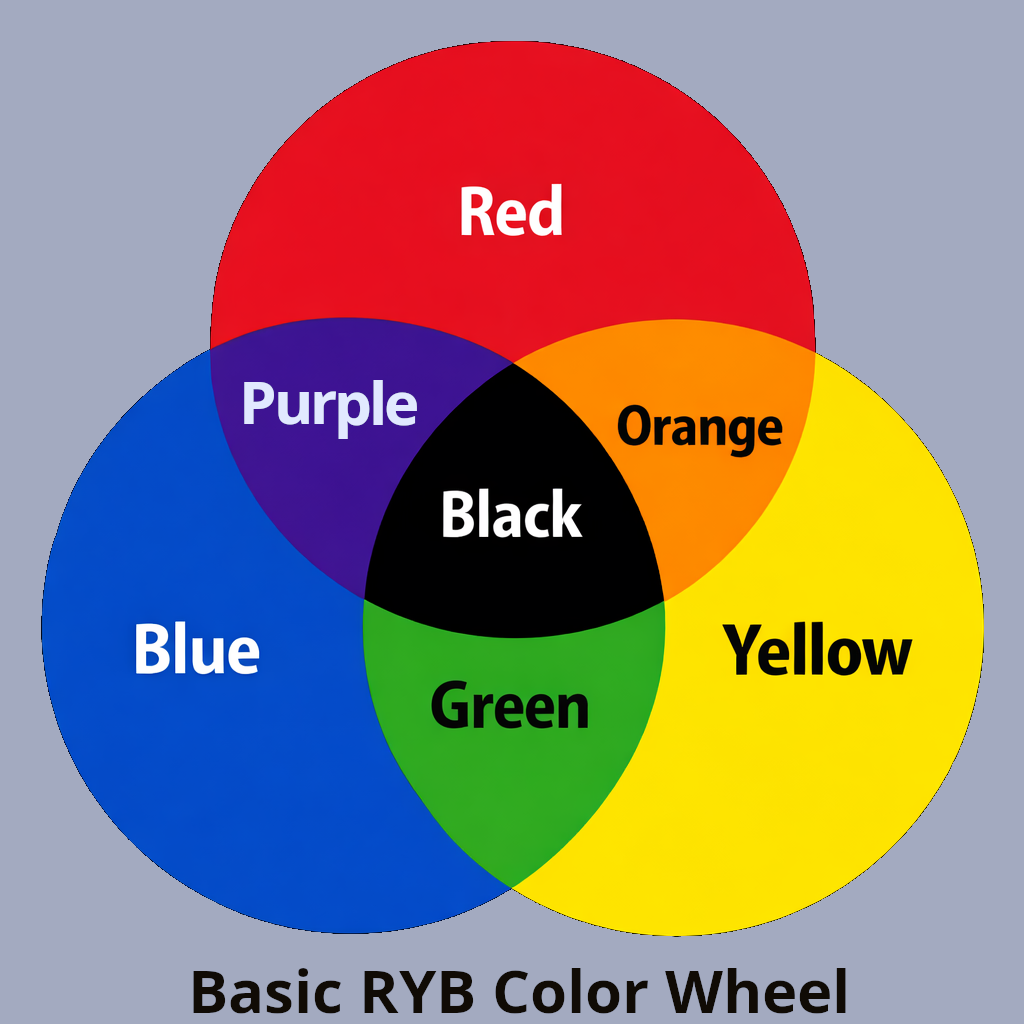
RYB Color Mixing - The Simple Version
RYB stands for Red, Yellow, Blue. It’s the traditional color system used in painting and art classes. These three colors are treated as the “starting colors“. You mix them to make almost everything else. Think of the color wheel like a map. Modern color systems used in design and film are more advanced than RYB, but RYB remains the practical system used for mixing food colors.
- Red + Yellow = Orange
- Yellow + Blue = Green
- Blue + Red = Purple
That’s it. Those are your basic mixes. Once you understand that triangle, you can make most simple colors by adjusting the amounts.
- More yellow -> warmer
- More blue -> cooler
- More red -> deeper
Color mixing isn’t exact math. It’s closer to cooking than chemistry. You add a little, look, adjust, repeat.
About amounts
Small changes matter. Depending on volume, a tiny drop of red can shift orange to coral. Too much blue turns green muddy fast. Start light. Add color slowly. Like using salt, it’s easier to darken a color than to fix one that went too far.
Why batter and icing behave differently
Color looks different depending on the material.
- Icing shows color strongly because it’s bright and opaque.
- Cake batter is beige and gets baked, so colors look weaker after cooking.
That means:
- Batter needs more color than icing
- Heat dulls color
- Baking shifts the tone slightly
If raw batter looks right, baked cake may look pale. Experienced bakers add a little extra on purpose.
A modern note
RYB is mostly used in art education now. Modern printing and design use a
different system:
CMYK (Cyan, Magenta, Yellow, Black)
It’s more accurate scientifically and more adjustable in coloring hues but RYB is still the easiest way to understand
basic color mixing by eye. That’s why artists still learn it. It teaches
intuition, not formulas. But CYMK is not used in mixing food colors, which are Red,
Yellow and Blue.
The takeaway
The wheel isn’t decoration. It’s a shortcut. If you want a color, look between the two colors that make it. Then adjust the balance. Color mixing is experimentation, not memorization. And mistakes are part of learning — every painter has made brown on accident. Mix up some small amounts of colors, and test them on different materials. Perhaps break up a mix of cookies, and try different amounts of colors on each part. This will help you see through the color as mixed with a light batter, and the color as completed with a darker finished look which will affect the resulting colors. Icings are easy to color because they are white. Perhaps start with icings first, then move along to baked goods.
Readers interested in modern color theory in visual design may enjoy Bruce Block’s The Visual Story (ISBN 9781138014152), which explores how color works in film and composition.